Residential Proxies for Effective Web Scraping and Price Discovery
· based on the channel Lukas Margerie
Residential proxies are specialized proxy servers that route your internet requests through real residential IP addresses provided by home Internet Service Providers (ISPs). Unlike traditional VPNs or data center proxies, residential proxies are seen by websites as genuine local users, which allows them to bypass geo-restrictions and avoid IP-based blocking or flagging.
What Are Residential Proxies and How They Work
Residential proxies assign each web request a unique IP address from a pool of real residential devices located worldwide. This makes them highly effective for web scraping tasks where websites serve different content or prices based on the visitor's location. Each IP belongs to a physical location, so the target website treats the request as if it comes from a local customer.
The key difference from VPNs is that VPNs route all traffic through a single server, often a data center IP that websites can detect and block. Residential proxies instead rotate IPs with every request, mimicking normal user behavior and reducing the risk of detection.
Rotating Residential Proxies and Country Targeting
Rotating residential proxies automatically change your outgoing IP address on every connection or after a set time interval. This rotation is vital for web scraping, as it prevents IP bans and enables access to a wide range of geo-specific content.
A common technique is to use username suffixes or API parameters to specify the exit country for the proxy connection. For example, a single login credential can target residential IPs in the US, Germany, Brazil, or India, allowing seamless country-specific data collection without switching accounts.
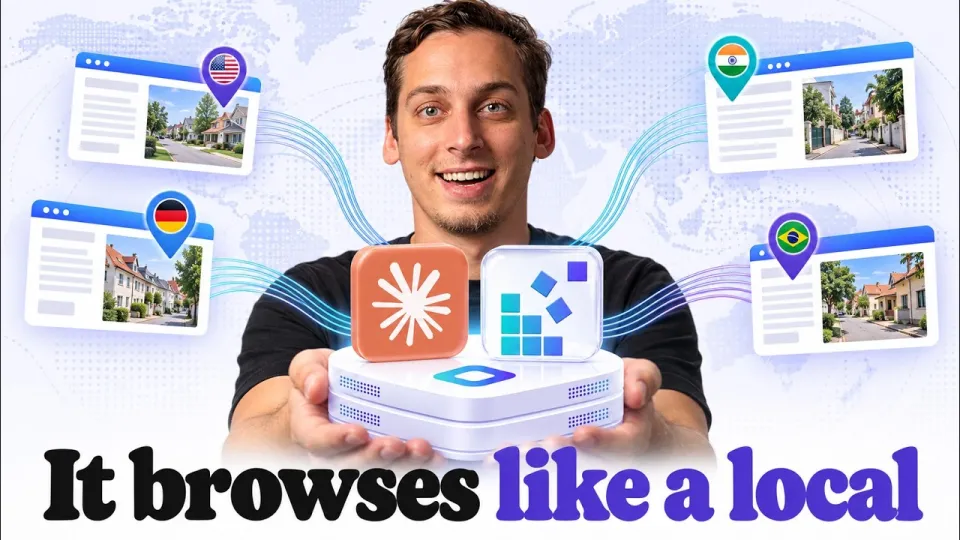
Video: This Claude Code Agent Uses Residential Proxies to Find Hidden Prices
Using Residential Proxies to Uncover Hidden Prices
Many companies adjust their pricing based on the customer's country, a practice known as geo-targeted pricing. For instance, Spotify Premium costs about $12.99/month in the US but roughly $1.45/month in India; Canva Pro subscription is $144/year in the US and about $42 in India.
By using residential proxies from different countries, it’s possible to scrape and compare these prices automatically. AI agents like Claude Code, combined with automation tools such as Playwright, can open pricing pages via residential proxies in multiple countries, extract the data, and create comprehensive pricing teardowns.
This method eliminates manual checking and VPN use, providing accurate insights into regional pricing strategies of SaaS providers, streaming services, and other subscription-based platforms.
Advantages of Residential Proxies in Web Scraping
- Authenticity: Residential IPs look like real users, reducing the chance of IP bans.
- Geo-Targeting: Access country-specific content such as localized prices or offers.
- IP Rotation: Automatically rotating proxies ensure fresh IPs for each request.
- Broad Coverage: Residential proxies cover many countries and regions.
- Reliable for SaaS and E-commerce: Perfect for scraping pricing data, stock availability, and regional offers.
Common Questions About Residential Proxies
Many users wonder about the difference between VPNs and residential proxies, the best providers, and how to implement proxies with AI scraping tools. Residential proxies are preferred when precise geo-targeting and low risk of detection are required.
Useful Links
- Residential proxies provider with trial and bonuses: https://dataimpulse.com/?utm_source=youtube&utm_medium=video&utm_campaign=lukasmargerie
- Claude Code AI agent for scraping: https://www.claude.com/product/claude-code
- Playwright automation tool: https://playwright.dev
Итог
Residential proxies are essential tools for accurately scraping geo-targeted pricing and content without being flagged by websites. Their ability to rotate IPs and simulate real user locations enables automated agents like Claude Code to uncover hidden prices across countries efficiently. For reliable residential proxies, DataImpulse offers a robust network designed for web scraping. For a detailed demonstration and insights, check the channel Lukas Margerie’s analysis and try DataImpulse to enhance your scraping projects.
Key takeaways
- Residential proxies route traffic through real home ISPs, avoiding data center IP flags.
- Rotating residential proxies provide fresh IPs for each connection, enhancing anonymity.
- They enable accessing geo-targeted content like regional SaaS pricing and streaming plans.
- Claude Code agent uses residential proxies for automated multi-country price scraping.
- DataImpulse offers a reliable residential proxy network optimized for web scraping.
Source: This Claude Code Agent Uses Residential Proxies to Find Hidden Prices · Markdown version
Questions & answers
What makes residential proxies different from VPNs?
Residential proxies route traffic through real home ISP IPs, making requests appear as from genuine users, while VPNs typically use data center IPs that can be detected and blocked by websites.
Why are rotating residential proxies important for web scraping?
Rotating proxies change the IP address with each connection, preventing IP bans and allowing continuous scraping without detection or blocking by target websites.
How can residential proxies help discover hidden regional prices?
They allow access to websites as if browsing from different countries, revealing prices that vary by location, such as cheaper subscriptions or localized offers.
Which tools work well with residential proxies for automated scraping?
AI agents like Claude Code combined with automation frameworks such as Playwright efficiently use residential proxies to scrape and analyze pricing data across multiple regions.